
The short answer
For custom waterproof rifle cases, provide a generic equipment-envelope drawing with the overall outline, projections and relevant access clearances. Allocate accessories to named spaces and state whether they are supplied with or separate from the main item. Review fit on the selected closed-case configuration and keep material, closure and protection requirements separate. The purchasing output is an equipment-to-storage map, not an assumption that a nominal case length establishes compatibility or protective performance.
Use an equipment envelope as the starting document
A long soft-case enquiry needs the outline of the item being stored, including projections that affect the opening or internal fit. An overall length by itself can miss a wider section, an attached fixture or an accessory that shares the storage space. Define the envelope in a drawing that a supplier can use without guessing from an angled photograph.
For custom waterproof rifle cases, keep this brief concerned with storage geometry and case configuration. Identify the representative item or an appropriate non-functional form used for fit review. State which accessories are part of that reference and which will be stored separately. A named equipment reference makes the later sample discussion more precise while avoiding an unsupported universal-fit claim.
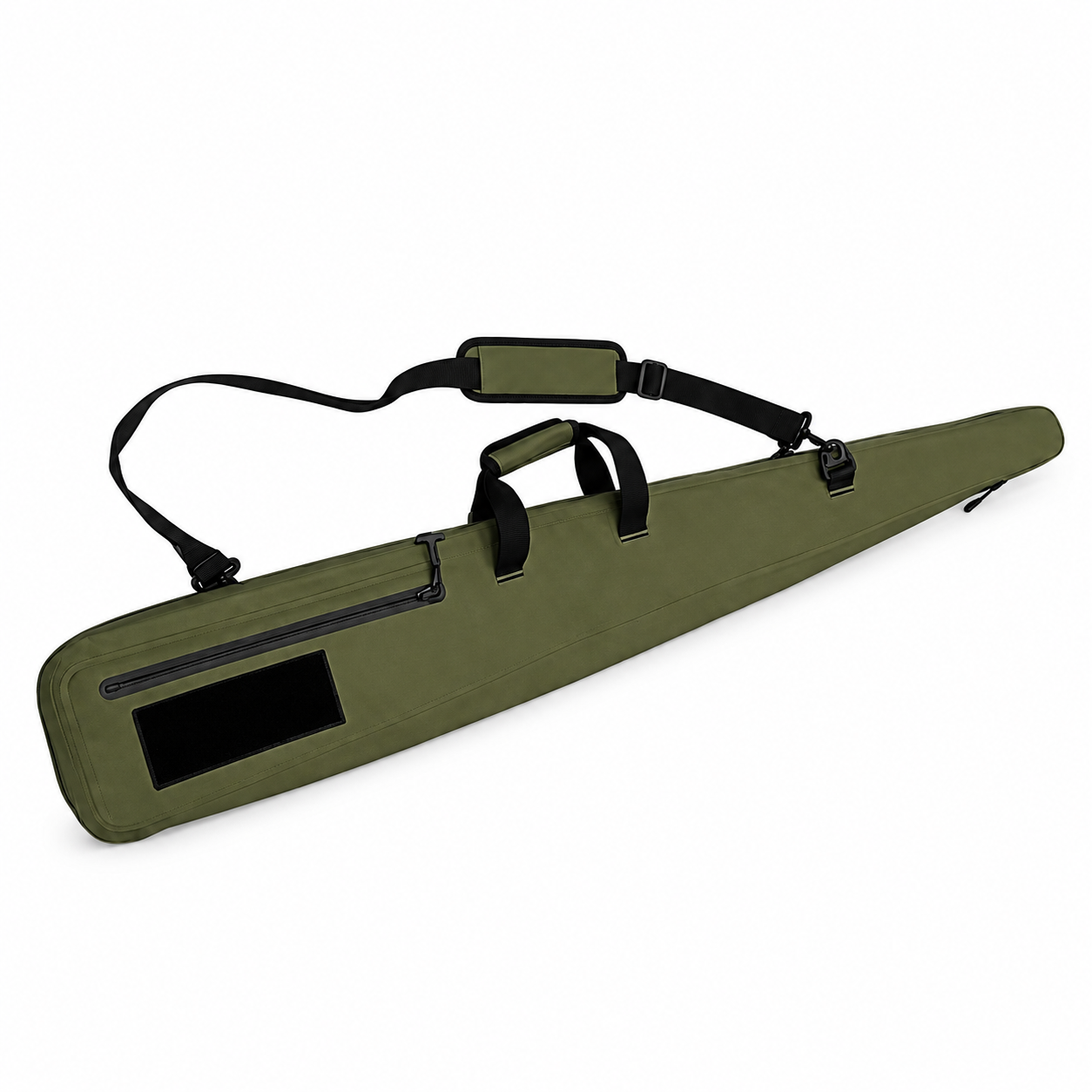
Review the long soft-case reference and long storage-pouch reference through the specialist case collection. The selected model still requires its own equipment-envelope review.
Draw the item outline and accessory allocation
Use consistent orientation labels and show the features that determine fit. Distinguish the equipment outline from any clearance requested around it. Mark the proposed storage position of each accessory rather than adding a broad allowance to one overall dimension.
| Brief field | What to identify | Decision supported |
|---|---|---|
| Main outline | Overall envelope and relevant projections | Body shape and clear opening requirements |
| Orientation | Which end and side correspond to the case drawing | Repeatable fit photographs and drawing callouts |
| Accessory space | Named items, their envelopes and intended locations | Separate or shared storage allocation |
| Access allowance | Space needed for insertion, removal and closure operation | The opening arrangement to review on the sample |
Ask the supplier to mark any interpretation that differs from the buyer's drawing. A proposed fit allowance should be agreed explicitly rather than hidden in an unrecorded pattern adjustment.
Review the opening before accepting the body dimensions
An item can fit within a body outline while remaining difficult to insert through the selected opening. Identify the intended access direction and review the actual opening on the completed sample. Note which section of the equipment envelope controls the access requirement.
Record closure operation after the representative contents are positioned. Check whether an accessory location obstructs the opening or the intended closing sequence. If padding, an insert or a separate internal component is proposed, identify it in the quotation and fit record; do not assume it is included because it appears in a reference rendering. Review the configuration that will actually be supplied.
Keep fit, construction and protection as separate approvals
A successful fit review answers a geometric question. It does not establish a material specification, cushioning result or finished-case water-protection claim. Identify the proposed shell, interior arrangement and closure in the product brief, then state any required evaluation separately.
Ask which storage areas the protection requirement covers and which sample revision would be evaluated. A product-name dimension should not be used as a confirmed internal measurement. Similarly, the general word waterproof should not replace the agreed function and acceptance criteria for the finished closed configuration. This allows purchasing and product-description teams to use the same defined information.
Illustrative brief: one equipment outline and a separate accessory set
A hypothetical specialist retailer wants a branded soft storage case for a defined equipment envelope and a separate set of accessories. The enquiry contains an outline drawing, a proposed orientation and a list showing which accessories share the case and which remain outside it. A non-functional form representing the relevant envelope is proposed for the fit review.
The supplier marks the opening and intended storage positions on the drawing. Reviewers record the form used, its orientation and the completed closure arrangement. If an accessory allocation changes, the drawing is revised before the fit decision is released. This example concerns storage-case development only; it does not present an actual order, a protective certification or evidence of compatibility with other equipment.
Release an equipment-to-storage map
The purchasing handoff should identify the selected case model, equipment-envelope revision, supplied internal components and accessory allocation. Add the accepted fit photographs and the clear opening description. Keep open construction or evaluation questions beside the relevant drawing callout so they cannot disappear into a general approval note.
Use the RFQ template for quantity, artwork and packaging information. Follow the sample approval process for the completed configuration. On a reorder, a change to the body shape, opening, internal component or intended equipment envelope should be checked against the same storage map before it is described as equivalent.
Discuss the selected model and purchasing brief
Send the model references, quantity split and the decision record described in this guide. Add your artwork, packing requirements, destination and required delivery date.
Request a project quotationEmail michael@outdoorsbloom.com or denggaoz@gmail.com.