
The short answer
Choose custom folding fishing buckets by the space they must occupy and the way they will be opened, carried and packed. Record the rim and base footprint, intended contents and folding sequence for each reference. A shared nominal capacity does not establish equal usable space or an equal packed size. Use a comparison worksheet that preserves the selected model, measurement condition and the practical reason for choosing a square or round body.
Choose the working footprint before the color
A square body and a round body answer different space-planning questions. A buyer may want a bucket beside other equipment, inside a particular storage area or on a display shelf. The relevant comparison is the actual opened and packed envelope, including handles and cover components, rather than the shape name alone.
For custom folding fishing buckets, identify the intended contents and where the bucket will be used or stored. Then compare the product references under named conditions. A soft body can change position as it is opened or loaded, so photographs taken in different states should not be treated as equivalent measurements. Keep the first review focused on the configurations you intend to buy.
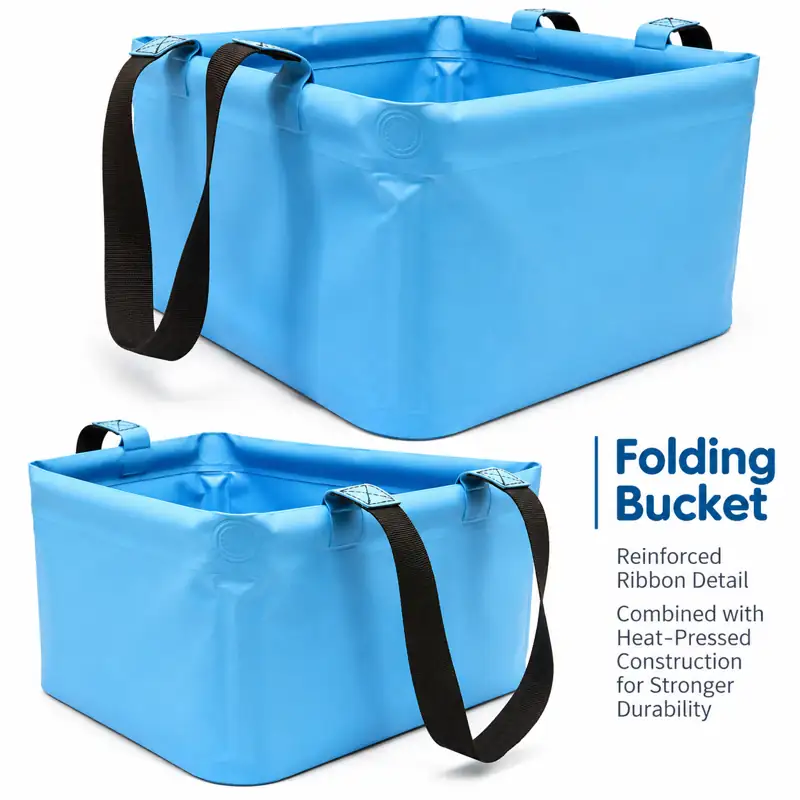
The square folding reference and round collapsible reference in the fishing-bucket collection are useful starting points. Their photographs identify formats; the order specification needs your selected dimensions and supplied configuration.
Compare the rim, base and usable working area
The opening footprint may differ from the base footprint. Measure and draw both, using consistent endpoints. Record which parts sit outside the body outline, such as a folded handle or closure component. This prevents a storage slot or display fixture being planned around only the fabric body.
| Comparison field | Square reference | Round reference | Decision supported |
|---|---|---|---|
| Opened rim | Record the outline and relevant spans | Record the outline and relevant spans | Access and space around the opening |
| Base contact area | Record the supporting footprint | Record the supporting footprint | Fit in the intended working location |
| External components | Show handles and covers in the reviewed position | Show handles and covers in the reviewed position | The complete occupied envelope |
| Folded unit | Record the agreed folding state | Record the agreed folding state | Storage and individual packing |
Add sketches or photographs to the worksheet. A drawing callout should state whether a dimension describes the outside envelope, the clear opening or the body itself.
Keep nominal capacity out of the shape decision
Matching capacity labels do not establish that two folding buckets offer the same useful opening or accommodate the same contents. Corners, taper, base shape and the condition of a soft wall can change the available envelope. Define the practical contents or working requirement separately, then confirm how any public capacity figure will be established.
If the buyer needs a particular object to fit, provide its envelope and the way it will be placed. If the comparison concerns a working fill level, identify that condition and the evaluation to be agreed. Do not select the shape by multiplying dimensions taken from unrelated photographs. That approach can compare two bounding envelopes while missing the actual working space.
Watch what happens between opened and packed
A folding bucket is handled in more than one state. Ask the supplier to demonstrate the proposed opening and folding sequence for the exact sample. Note the position of the rim, base, handles and any cover during the transition. Review whether loose parts are removed, retained or packed separately.
Record the folded dimensions after following the agreed sequence rather than after forcing the body into a convenient photograph. Identify any storage instruction that needs to accompany the product. The bucket-bag closure guide can support a different roll-top brief; it should not be used to assume that a square or round folding reference has the same opening or closing construction.
Illustrative brief: fitting a retailer's equipment display
A hypothetical fishing-equipment retailer is comparing square and round folding buckets for a coordinated accessory range. The buyer provides the space available in the display and the envelope of the contents used during sampling. Each supplier reference is photographed opened, with its handle in the intended position, and folded for its proposed unit pack.
The worksheet records the rim and base separately. The buyer selects a format because it meets the defined access and display brief, not because its label resembles the capacity on another reference. The rejected format remains in the comparison with the reason recorded. If the contents or display fixture later changes, the purchasing team can see which assumption needs a new review.
Release a shape decision with reproducible conditions
The handoff contains the selected model, opened drawing, contents reference, folded state and supplied accessory list. Identify which observations are measurements and which are reviewer comments. Keep material, printing and any required performance evaluation as separate approval lines so a visual shape choice does not silently approve them.
Use the sample approval process to tie these records to the accepted revision. A future change to the rim, base or cover may alter the working and packed envelopes even when the nominal capacity is unchanged. Compare that change against the original worksheet before accepting it into the range.
Discuss the selected model and purchasing brief
Send the model references, quantity split and the decision record described in this guide. Add your artwork, packing requirements, destination and required delivery date.
Request a project quotationEmail michael@outdoorsbloom.com or denggaoz@gmail.com.