
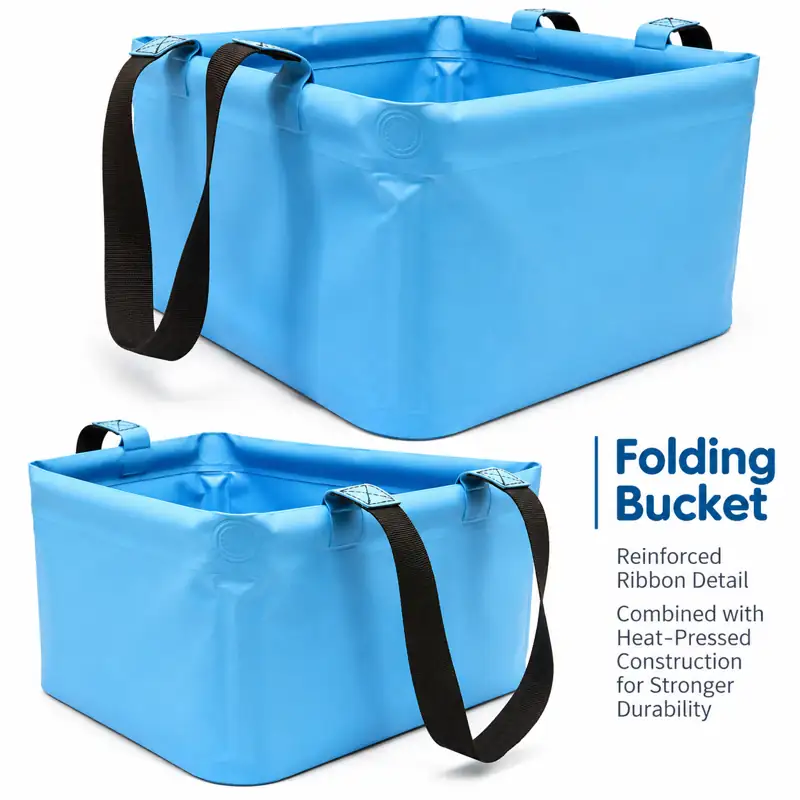
The short answer
A collapsible fishing bucket manufacturer needs a drawing that names the rim, base and height reference points and states the condition in which each measurement is taken. Record external envelope and clear opening separately. Review any working fill or loading condition as a distinct agreed configuration. The resulting dimension record should identify the sample revision and measurement method; it should not treat a simple geometric calculation as verified usable capacity.
Name the condition before recording a number
A flexible bucket may look different when partially opened, fully arranged, loaded or folded. A drawing that omits the measurement condition leaves room for disagreement even if every dimension is written clearly. Begin the enquiry by identifying the state being described and the features used to locate each endpoint.
Ask the supplier to show the sample on the intended supporting surface in the agreed opened condition. Record whether handles or covers are included in the outside envelope and which parts are arranged away from the measurement. Where a different working condition matters, give it a separate row. This lets a collapsible fishing bucket manufacturer compare requirements without trying to reconcile measurements taken in different states.
Use the square folding bucket or clear-grid bucket reference to mark the proposed datums. The bucket collection shows several formats, so keep the model identity beside every drawing.
Separate the rim, base and height datums
Draw the opening and base as different views. Identify where a rim measurement begins and ends, especially if the edge includes a fold, binding or another component. Define height between named levels rather than measuring whichever wall happens to sit highest in a photograph.
| Datum | What the drawing must identify | Condition to record |
|---|---|---|
| Rim envelope | The outside outline and measured spans | Opened state and position of attached components |
| Clear opening | The space available through the selected opening | Cover or closure position during measurement |
| Base | The supporting outline and its reference points | Supporting surface and body arrangement |
| Height | The two levels or points defining the dimension | Whether the body is empty or in another agreed state |
Include a photograph in which the measurement points can be recognised. A scale in an oblique photograph is a useful visual record, but it does not replace a drawing with defined endpoints.
Agree how variation will be reviewed
Soft products should not be assigned a universal tolerance copied from a different bag. Discuss which dimensions affect the buyer's use and ask the supplier to propose an appropriate measurement approach and acceptance range. Record the accepted range only after the parties have agreed it for the selected construction.
Separate an intended design dimension from a sample reading. If several readings differ, note the condition and repeat the agreed measurement before changing the specification. A variation caused by a different body arrangement is not necessarily the same issue as a production dimension outside an accepted range. This distinction helps the sample discussion focus on a reproducible requirement.
Keep an envelope estimate separate from usable capacity
A geometric estimate based on an external outline describes an envelope, not automatically the contents a finished soft bucket can usefully hold. Wall shape, taper, rim construction and the chosen working condition can all affect the interpretation. State the purpose of a calculation rather than allowing it to become a sales figure by default.
If capacity will appear on packaging, agree how it will be established, what condition it describes and which model revision the result belongs to. Keep any recorded result with its method and sample identity. The capacity assortment planning guide explains why a capacity term needs an agreed meaning; its dry-bag context should not be used as a measurement method for every bucket construction.
Illustrative brief: a bucket that must fit a storage bay
A hypothetical wholesale buyer wants a folding bucket to fit an existing storage bay when packed and leave a defined working area when opened. The enquiry contains separate opened and folded drawings. The opened drawing names the rim and base outlines; the folded drawing includes the complete supplied set in its proposed pack.
The supplier returns a sample with a marked datum sheet. Reviewers record the measured readings in the agreed state and photograph the endpoints. The buyer does not infer usable capacity from the storage-bay envelope. Any capacity description remains a separate requirement to be resolved with its own method and record. This keeps a fit decision from becoming an unsupported performance or volume claim.
Hand over a measurement record that survives a reorder
Retain the drawing revision, sample identity, agreed state, datum definitions, readings and acceptance decisions. State which dimensions remain informational and which control the order. A record should also identify who measured the sample and whether an observation was repeated after the body was rearranged.
Before release, compare the approved drawing with the quotation and unit-pack description. Follow the sample approval process for the accepted configuration. If a rim, cover, handle or packing change affects a datum, issue an updated measurement record instead of retaining a number whose meaning has changed.
Discuss the selected model and purchasing brief
Send the model references, quantity split and the decision record described in this guide. Add your artwork, packing requirements, destination and required delivery date.
Request a project quotationEmail michael@outdoorsbloom.com or denggaoz@gmail.com.