
The short answer
An insert brief should state the user problem, packed contents, proposed outline, removal route and preferred retention concept. Compare options on the selected cooler while identifying any changes to its main construction. Keep organization requirements separate from sealed-compartment or other performance requirements. Approve the cooler and optional component as one supplied set, with distinct revisions, attachments, instructions and packing photographs for receiving and reorders.
Define the problem an insert should solve
A request for custom soft coolers with a divider should start with the contents and the desired separation. The buyer may want containers to remain in distinct positions, a removable organizer for receiving, or an easier way to retrieve one item. Those are different development purposes and may lead to different proposals.
Describe the items in their packed condition and identify which should be removed independently. State whether the proposed divider remains in place during loading, can be removed with contents, or is removed before the cooler is folded for storage. Do not assume an insert is included simply because a product reference has a suitable-looking interior.
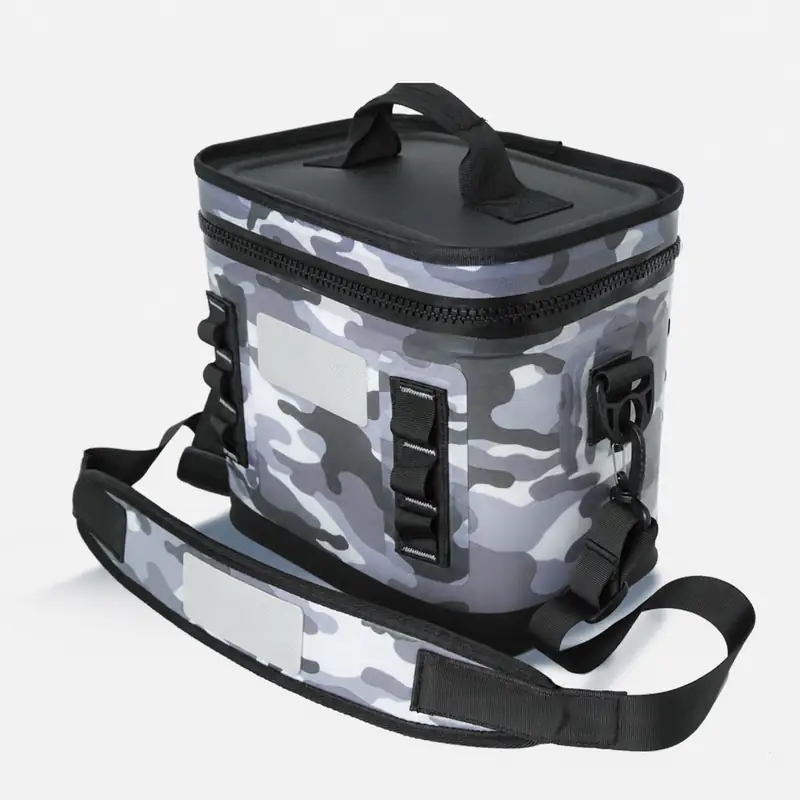
Use the picnic soft cooler reference or KB02 cooler backpack reference to identify a starting body. An added divider or insert remains a proposal for construction review.
Draw both the fit envelope and the removal route
The drawing should show the proposed insert outline, its position inside the body and the space required for the contents. Mark any handle, tab or attachment concept separately. Record the intended relationship to the cooler opening so the review can address insertion and removal rather than only the fit once the insert is inside.
Specify whether the concept is loose, attached or retained by another component. Ask the supplier to identify which parts of the existing cooler construction would change. A retained insert might require an attachment decision; a loose insert may need a clearer packing position and identification method.
Keep proposed material and construction choices open for review until they are quoted and sampled. The development brief should state the function and constraints without presenting an unverified material combination as an available factory standard.
Compare concepts by access and completeness
| Question | Information to supply | Decision to document |
|---|---|---|
| Fit | Container envelopes and proposed position within the selected cooler. | Whether the arrangement fits with the required opening and closing allowance. |
| Removal | What is removed first and which parts remain attached. | The accepted load-in and removal sequence. |
| Retention | Whether the insert should be loose, attached or retained by a proposed component. | The attachment scope and any resulting changes to the main body. |
| Care access | Surfaces that need to be reached after use. | Which parts separate and how they are reassembled under the proposed instructions. |
| Packing | How the insert appears in the unit pack and carton. | Its identifier, quantity and whether assembly is required after receiving. |
Separate organization from protection requirements
A divider can describe the intended location of contents without defining a sealed compartment. If the buyer requires separation of liquids, contact or temperature conditions, state that requirement explicitly and ask how the proposed construction would be evaluated. Do not let a drawing line become an unsupported performance claim.
Similarly, a removable part does not by itself settle cleaning access or material compatibility. Review how the selected parts are handled together and request instructions for that configuration. Keep any required material or finished-product evidence distinct from a simple demonstration that the part can be lifted out.
The private-label insulated range guide helps establish the broader collection. This insert brief narrows that program to one optional development item with its own drawing, component list and approval record.
Illustrative concept: separate a lunch set from loose accessories
A buyer proposes an organizer that keeps a lidded lunch set on one side of a soft cooler and loose accessories on the other. This is an illustrative development brief; it does not state that the referenced coolers contain a divider.
Two sketches are submitted: one loose organizer removed before the bag is stored, and one retained partition concept. The supplier is asked to identify changes to the cooler body, supplied components and sample scope for each option. The buyer then compares loading, selected-item access and the removal sequence using the same contents.
If the retained concept obstructs access to the bottom of the liner, the buyer can reconsider the concept or its outline. The record should explain that decision. It should not label the alternative “better” without saying which user task it improves.
Release the optional component as part of the supplied set
Send the chosen body reference from the cooler collection, proposed insert drawing, contents list, preferred concept and quantity schedule. Ask the quotation to distinguish the base product from the additional development and supplied parts.
The approved set should identify the cooler revision, insert revision, attachments, instructions and packing arrangement. Keep a photograph of all components laid out together, followed by the accepted assembled configuration. That handoff gives an OEM soft coolers project a clear completeness check and makes future reorders less dependent on a photograph that hides the optional part inside the bag.
If the insert is optional in the retail range, assign separate supplied-set codes for versions with and without it. Keep those codes on the order and packing schedule so a price comparison or receiving check does not treat the two configurations as interchangeable.
Discuss the selected model and purchasing brief
Send the model references, quantity split and the decision record described in this guide. Add your artwork, packing requirements, destination and required delivery date.
Request a project quotationEmail michael@outdoorsbloom.com or denggaoz@gmail.com.