
The short answer
Assign the insert a model and revision, then build its operation sequence from photographs of the selected closure. Review pre-use and care wording for that configuration without adding unsupported depth, flotation or compatibility claims. Check each language proof at its intended print size and approve it with the complete packed unit. Keep the product revision, instruction version and pack code linked so the correct information reaches the customer.
Give the instruction insert a product identity
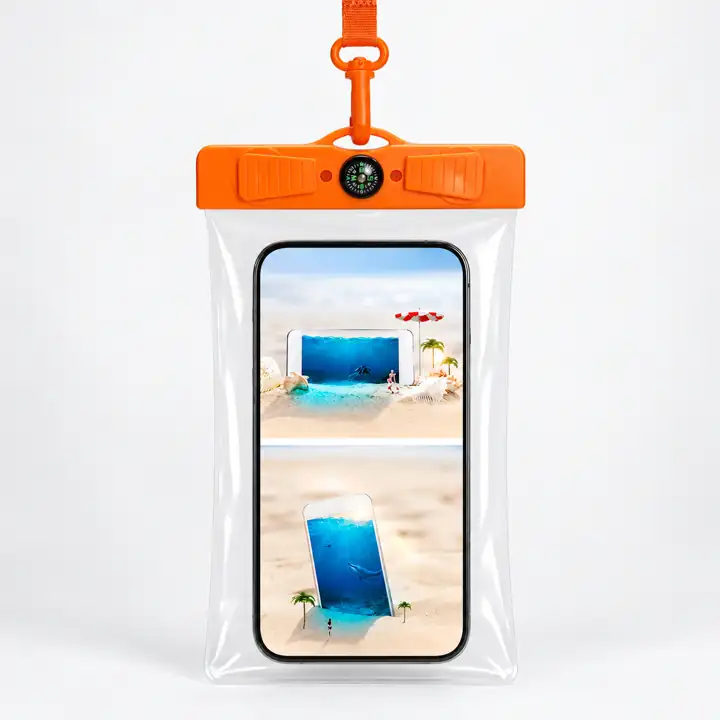
For custom waterproof phone pouches, the instruction insert belongs to a selected model and configuration. It should not be treated as a generic card that can be moved between pouches with different closures or attachment arrangements. Begin the proof with a model identifier and a clear photograph of the product it explains.
Record the body, closure version and supplied lanyard or accessory set beside the insert revision. If several retail units share one instruction design, state exactly which configurations it covers. A similar silhouette does not establish that the same opening, closing or care illustrations are appropriate.
The clear single-hook reference and clear gusseted reference should each be reviewed against their actual supplied construction before sharing an insert.
Build the sequence from the selected closure
Request photographs showing the closure in the states needed to explain its use. Agree which views demonstrate opening, loading, closing and checking the engaged condition. The instruction writer needs the actual mechanism, not a set of drawings copied from another pouch with a different number or position of fastening parts.
Keep the user's hand position and the product orientation understandable between illustrations. If the view changes from front to back, label that change. Ask a reviewer with the physical sample to follow the proof and identify any action or component that the drawings leave ambiguous.
Use the closure and lanyard review guide to identify the components that need approval. The insert should explain the approved arrangement rather than introduce a new closure routine after the product sample has been accepted.
Separate instruction content from unverified claims
| Proof element | Required input | Approval question |
|---|---|---|
| Model image | Approved front and closure photographs. | Does the illustration identify the same supplied product? |
| Closing sequence | Supplier-confirmed actions and engaged-state view. | Can the reviewer follow every depicted step on the selected sample? |
| Pre-use check | The documented method and wording proposed for this configuration. | Are the check, expected observation and action on a problem stated without inventing a universal test? |
| Care and storage | Instructions applicable to the actual materials and components. | Do the words match parts that are removable, fixed or separately supplied? |
| Claims and limitations | Approved model-specific wording and supporting information where required. | Have unsupported depth, duration, universal-device or flotation statements been excluded? |
Review the proof as a user task, not a marketing panel
Keep operational instructions separate from promotional slogans. A small panel filled with sales copy can leave little space to explain the actual closure. Decide which information belongs on the pack, which belongs in the insert and which should be available in a linked product resource.
For each language version, keep the same illustration numbers and product orientation. Have the final translated proof reviewed against the approved master and the physical sample. A translation should preserve the meaning of the agreed operation and limitations; it should not silently broaden a product claim to make the wording sound stronger.
Review the proof at the intended printed size. Check whether small closure details, arrows and captions remain distinguishable and whether fold lines divide an instruction from its illustration. Record print-size corrections as part of the insert revision.
If the insert uses a QR code or online instruction link, check the destination against the same model identity and language. Assign responsibility for maintaining that destination when an instruction changes. A link to a general collection page should not be mistaken for the model-specific operating information promised by the printed card.
Illustrative proof: two closures in one retail program
A buyer proposes a branded program containing two phone pouch references. The retail artwork shares colors and typography, but the closure photographs show different fastening arrangements. This is an instruction-development example, not a completed order.
Instead of approving one universal operation panel, the buyer creates two model-specific instruction versions with a common visual style. Each proof includes the model image, its own closing sequence and the applicable pre-use and care wording supplied for review. The unit-pack code identifies which insert belongs with each pouch.
During review, one illustration is found to show a component from the other model. The buyer corrects that proof before approving the packed unit, then checks the final product, insert and pack together. Sharing a brand design does not require sharing inaccurate operational pictures.
Release the insert with the complete packed unit
Send the selected models from the waterproof phone pouch collection, approved photographs, proposed claims, languages and retail-pack dimensions with the artwork brief. Ask for a proof tied to each actual configuration.
The handoff record should identify product revision, instruction revision, language versions, printed size and pack code. Keep photographs of the complete packed unit and a readable copy of each approved insert. For OEM waterproof phone pouches, that relationship is the useful control: the instruction reaching the customer must explain the product in that same pack.
Discuss the selected model and purchasing brief
Send the model references, quantity split and the decision record described in this guide. Add your artwork, packing requirements, destination and required delivery date.
Request a project quotationEmail michael@outdoorsbloom.com or denggaoz@gmail.com.